
Here’s a number that should get every shipowner’s attention: $319.
That’s the EU ETS compliance cost per tonne of VLSFO burned on an intra-EU voyage in 2026. It was $185 last year. And just $91 in 2024.
In two years, the carbon cost of moving cargo through European waters has more than tripled. And that’s just one of three emissions regimes now bearing down on ship operators simultaneously.
2026 is not an incremental year for maritime compliance. It’s a convergence. EU ETS has reached 100% phase-in, now covering methane and nitrous oxide alongside CO₂. FuelEU Maritime’s first penalties are due by June. The UK ETS launches in July. And CII rating thresholds continue to tighten, with an 11% reduction now required against the 2019 baseline.
The companies that are still managing this on spreadsheets are not just behind — they’re exposed.
Ocean is going green @ Ecosail Infotech
From Annual Paperwork to Daily Operations
The regulatory landscape has fundamentally changed. Compliance used to mean filing a report once a year. Today, regulations like IMO-DCS, CII, EU-MRV, EU ETS, and FuelEU Maritime require continuous monitoring, real-time calculation, and forward-looking decision-making.
Consider what’s now required of a single vessel trading between EU and UK ports:
- CII: Annual carbon intensity rating (A–E), tightening ~2% per year
- EU ETS: Surrender EU Allowances covering 100% of CO₂e by 30 September
- FuelEU Maritime: GHG intensity verified and penalties assessed by 30 June
- UK ETS: Separate UK Allowances for domestic voyages from 1 July 2026
- EU MRV: Verified emissions report submitted by 31 March
Five overlapping obligations. Different reporting bases. Different deadlines.
Different allowance markets. One vessel.
Traditional spreadsheet-based tracking cannot handle this complexity. The leading operators have already moved to integrated digital platforms that collect real-time fuel and voyage data, calculate CO₂e emissions automatically, simulate CII ratings before a voyage begins, and forecast EU ETS exposure against live carbon prices.
Compliance is no longer reactive. It is predictive.
AI Is No Longer Optional — It’s Operational
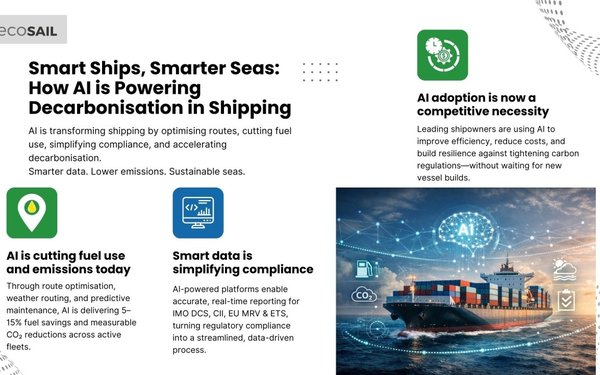
Artificial intelligence is moving from pilot projects to production systems in maritime operations. And the business case is now driven as much by compliance as by efficiency.
Modern AI-driven systems can predict fuel consumption based on weather, cargo load, and hull condition. They can optimise speed and route for minimal fuel burn, detect propulsion inefficiencies before they escalate, and recommend trim adjustments for bulk carriers that yield measurable CII improvements.
The financial impact is direct. A bulk vessel operating within the EU could face approximately €1.3 million in annual ETS costs at 2026 rates. Every percentage point of fuel efficiency gained through AI optimisation translates directly into reduced allowance obligations.
Instead of discovering inefficiencies during an annual audit, operators now adjust performance in real time — and see the compliance and cost benefits immediately.
ocean is going digital @ Ecosail Infotech
Digital Twins: Simulating Compliance Before It Happens
Digital twin technology creates a live virtual model of a vessel using engine performance data, voyage inputs, weather patterns, and fuel metrics. It’s one of the most powerful tools available for proactive compliance management.
With a digital twin, fleet managers can simulate the impact of speed changes on CII ratings before committing to a voyage plan. They can model long-term emissions projections across an entire fleet, evaluate fuel-switching scenarios — such as blending biofuels or transitioning to LNG — and quantify the compliance impact. They can even assess how deferred maintenance affects both efficiency and CII ratings over time.
For CII in particular, this is critical. Rating thresholds tighten roughly 2% per year, meaning a vessel that earned a comfortable C rating in 2023 may drift to D by 2025–2026 without operational changes. Ships rated D face 5–15% charter rate discounts, and those rated E risk becoming uncharterable in certain trades.
Digital twins reduce uncertainty and replace gut-feel decisions with data-driven confidence.
Emissions Now Equal Financial Strategy
With shipping fully embedded in the EU Emissions Trading System and FuelEU Maritime imposing its first penalties, carbon output is no longer an environmental metric alone — it is a direct financial variable.
The new equation:
Emissions = Allowance Cost (EU ETS: €60–€150/tCO₂e in 2026)
CII Rating = Commercial Attractiveness (D/E = 5–15% rate discount)
Fuel Choice = Financial Risk (methane slip on LNG now priced into EU ETS)
GHG Intensity = Penalty Exposure (FuelEU: €2,400/MT VLSFO equivalent)
Advanced maritime platforms now integrate real-time CO₂e tracking across all three GHGs, carbon price forecasting tied to EUA market data, voyage-based emissions cost modelling, and multi-year compliance simulations that span EU ETS, FuelEU, UK ETS, and CII simultaneously.
Compliance is no longer regulatory paperwork. It is financial planning.
Securing trust in carbon data @ Ecosail Infotech
Securing Trust in Carbon Data
As carbon markets expand and compliance penalties escalate, the integrity of emissions data becomes commercially critical. Regulators, charterers, financiers, and insurers all need confidence that reported data is accurate, auditable, and tamper-proof.
Emerging technologies — including blockchain-based verification systems — are beginning to address this need. Early applications focus on securing emissions data provenance, tracking verified carbon credits to prevent double-counting, and ensuring audit transparency across multi-party supply chains.
While still maturing in maritime, these data integrity tools will become essential as compliance frameworks like FuelEU Maritime require verifiable well-to-wake lifecycle data across complex fuel supply chains.
Eco-Compliance Module @ Ecosail Infotech
The Human Dimension
Technology alone doesn’t solve compliance. The operational culture on board and ashore must evolve alongside the digital tools.
Fleet managers need new competencies in carbon economics and multi-regime regulatory navigation. Shore-based teams must understand how to interpret CII projections, manage EUA procurement strategies, and coordinate FuelEU pooling decisions. And the crew on board — the people actually operating the vessel — need practical training on how their daily decisions about speed, trim, and fuel management directly affect both emissions ratings and the company’s bottom line.
The most successful digital transitions in maritime are those that invest equally in technology and in the people who use it.
The Ecosail Infotech Vision
At Ecosail Infotech, we believe the future of maritime lies in intelligent integration — bringing compliance, operations, and commercial strategy into a single connected ecosystem.
Our focus is on building digital platforms that bring together:
▸ Maritime compliance automation — unifying CII, EU ETS, FuelEU, and UK ETS into one workflow
▸ AI-driven emissions management — predictive analytics for fuel, route, and speed optimisation
▸ EU ETS cost monitoring — real-time EUA exposure tracking and procurement support
▸ FuelEU Maritime readiness tools — GHG intensity simulation, pooling strategy, and penalty forecasting
▸ Data integrity and auditability — ensuring every data point is traceable, verified, and regulator-ready
Our mission: Simplify compliance. Optimise operations. Power sustainability.
Because the smart ship era has already begun.
Over to You
The maritime industry is transforming faster than at any point in its history. Three carbon pricing regimes are now live or launching this year. CII ratings are tightening. And the financial stakes of emissions management are measured in millions, not margins.
The question is no longer whether digitalization is necessary. It’s whether your fleet is ready for predictive compliance and data-driven sustainability.
If your organisation is navigating IMO-DCS, CII, EU-MRV, EU ETS, or FuelEU Maritime — what’s your biggest compliance challenge heading into the second half of 2026?
Let’s move shipping toward smarter, cleaner horizons.