The shipping industry — responsible for nearly 3% of global carbon emissions — is undergoing one of the most significant digital transformations in its history. With new IMO regulations, tightening carbon targets, and fuel costs that can make or break balance sheets, Artificial Intelligence (AI) is no longer a futuristic concept. It’s now a core enabler of efficiency, safety, and decarbonisation across the global maritime ecosystem.
AI Integration in Marine Technology — The State of Play
From navigation and performance analytics to autonomous vessel control, AI has moved from pilot projects to full-scale deployment. Recent industry reports and launches prove that AI is already reshaping how vessels move, burn fuel, and report emissions:
- A.P. Moller–Maersk has rolled out its Star Connect platform — an AI-powered energy efficiency system that processes more than 2.5 billion IoT data points in real time, enabling route, trim, and speed optimisation across over 700 vessels.
- StormGeo reports having optimised 74,900+ voyages in 2024, saving over 514,000 metric tons of fuel through AI-driven weather routing and bunker management.
- Hyundai Glovis and Avikus have begun deploying AI-controlled autonomous car-carrying vessels — the largest of their kind at over 750 ft, as reported by TechRadar (July 2025).
- In Australia, an AI-powered underwater robot trial by Manly Fast Ferry slashed diesel consumption by 13 % by automatically cleaning hulls and reducing drag (Daily Telegraph, Mar 2025).
These are not experimental prototypes — they represent active, measurable results that are reducing costs and emissions today.
How AI Directly Reduces Maritime Emissions
AI contributes to decarbonisation through several interlinked mechanisms:
- Route, Weather, and Speed Optimisation By analysing wind, current, and sea-state data, AI dynamically recommends the most fuel-efficient course and speed. Reuters (Jun 2024) estimated AI-based navigation could cut global maritime emissions by up to 47 million tons of CO₂ annually.
- Predictive Maintenance and Hull Health AI sensors detect early inefficiencies — from propeller fouling to machinery vibration — allowing proactive maintenance before fuel waste escalates.
- Smart Decision-Support for Crew AI-driven dashboards inform officers when to adjust speed or trim for optimal efficiency. Behavioural studies show this feedback loop can drive an additional 3–5 % efficiency gain without hardware upgrades.
- Fleet-Wide Edge Computing With real-time data processing onboard, systems like Star Connect give captains live insights — reducing drag, improving course stability, and mitigating roll risk — all contributing to measurable emission reductions.
- Digital Transparency for Carbon Tracking AI platforms now feed verified data directly into emissions reports, enabling accurate EU ETS, IMO DCS, and CII compliance — turning decarbonisation from guesswork into a data-driven discipline.
Leading the Change — Major Players to Watch
- Maersk: Targeting full carbon neutrality by 2040, with AI-powered analytics underpinning its fleet efficiency roadmap.
- StormGeo : Integrating machine learning in weather routing and bunker optimisation.
- Kongsberg Maritime and ABB: Embedding AI in propulsion, navigation, and dynamic positioning systems.
- Orca AI: Delivering collision-avoidance and fuel-efficiency insights via computer vision and voyage analytics.
- Windward AI: Supporting predictive compliance and emissions intelligence for charterers and regulators.
Each of these players showcases a trend: AI is merging with sustainability, transforming vessels into smart assets that continuously learn and optimise.
Why It Matters for Maritime Leaders
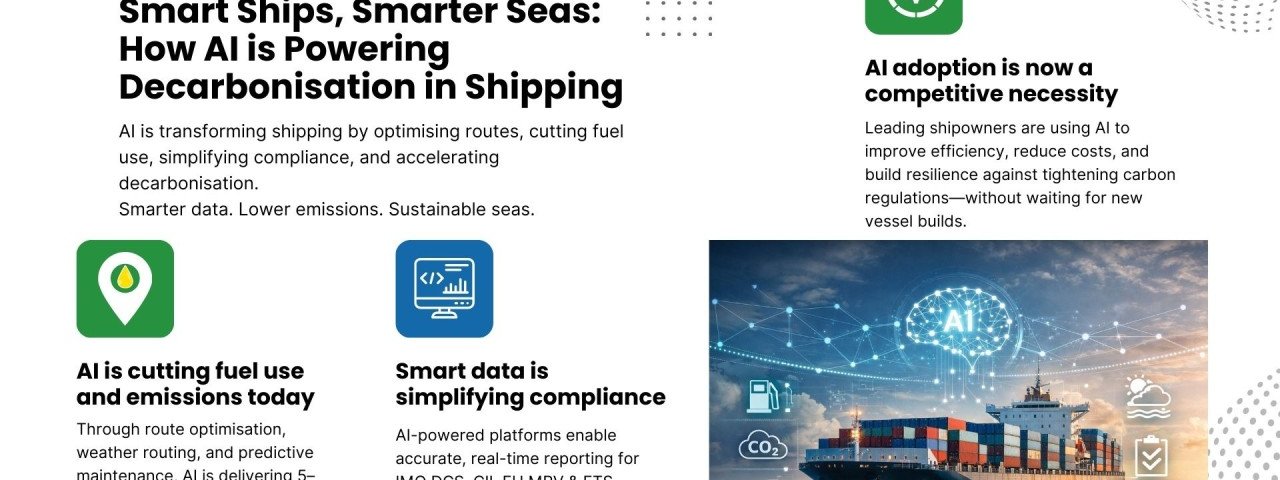
For shipowners, operators, and sustainability strategists, the message is clear: AI adoption is now a competitive necessity — not a luxury.
- Operational savings of 5–15 % on fuel can be achieved through existing assets, without new ship builds.
- Regulatory resilience improves as AI tools simplify compliance reporting for ETS, MRV, and CII frameworks.
- Carbon transparency creates opportunities for verified carbon credit generation — especially when paired with blockchain-based verification systems.
As highlighted at London International Shipping Week 2025 (Windward AI report), the global conversation has shifted from “why AI?” to “how fast can we scale it?”
The Next Horizon — From Efficiency to Autonomy
With autonomous navigation trials already underway, the maritime sector is moving toward self-optimising fleets. From AI-based bunkering decisions to real-time carbon tracking and digital twins of ships, the ecosystem is becoming more connected, efficient, and accountable.
The result? Smarter ships for smarter seas — and a measurable step toward net-zero shipping.