Introduction
The global maritime industry, responsible for over 80% of global trade by volume, faces a significant environmental challenge: the transfer of invasive aquatic species through ballast water discharge. Ballast water, essential for maintaining ship stability, often carries microorganisms and marine species from one region to another. When discharged into foreign ecosystems, these species can become invasive, disrupting local biodiversity, causing ecological damage, and incurring significant economic costs.
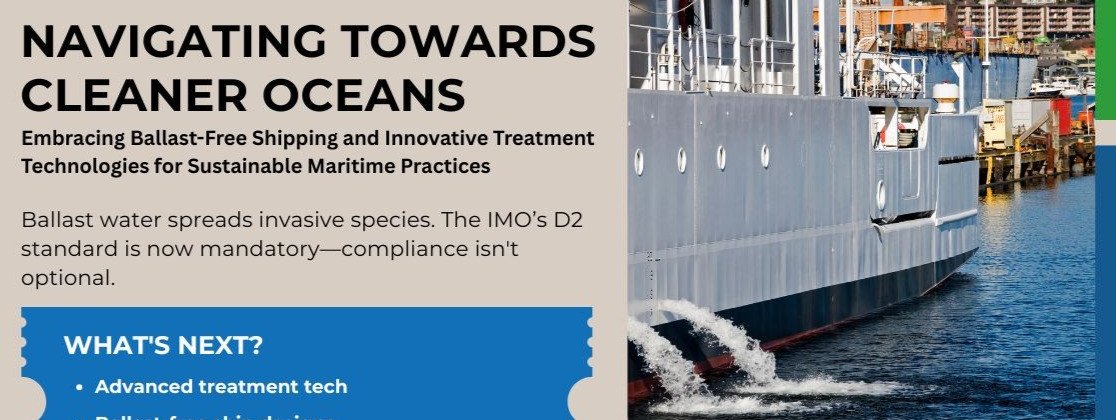
To mitigate these risks, the International Maritime Organization (IMO) introduced the Ballast Water Management (BWM) Convention, which came into force in 2017. This pivotal regulation mandates ships to manage their ballast water to prevent environmental harm. As of September 2024, all ships must comply with the D2 standard, requiring the use of approved ballast water treatment systems. In light of these developments, industry stakeholders are exploring both treatment technologies and ballast-free shipping designs as sustainable solutions.
The Environmental Impact of Ballast Water
Ballast water is taken in by ships to ensure structural stability and navigational safety, particularly when cargo is unloaded. However, this practice inadvertently transports marine organisms, including bacteria, viruses, plankton, and small invertebrates, across the globe. These organisms often survive long voyages and are released into new environments where they may lack natural predators.
Notable examples of ecological disruption include the introduction of the zebra mussel in North America and the North Pacific seastar in Australian waters. These invasive species have overwhelmed native populations, clogged industrial pipelines, and caused extensive economic damage. The World Bank estimates that invasive aquatic species introduced through ballast water cause over $100 billion in damages globally each year.
IMO's Regulatory Framework and the BWMS Code
To address these issues, the IMO established the BWM Convention. Under this framework, ships must adhere to two standards:
- D1 Standard: Involves exchanging ballast water in open seas, at least 200 nautical miles from shore.
- D2 Standard: Requires treatment of ballast water using IMO-approved systems to ensure minimal viable organisms are discharged.
To ensure consistent and effective implementation of these requirements, the IMO adopted the Ballast Water Management System (BWMS) Code through Resolution MEPC.300(72) during MEPC 72. This Code sets out technical and procedural standards for approving and operating BWMS. The BWMS Code became mandatory in October 2019 and includes:
- Type approval protocols
- Operational monitoring standards
- Installation and maintenance requirements
- Crew training guidelines
The latest developments from MEPC 83 (April 2025) further advance the BWM agenda. MEPC 83 endorsed new testing protocols for ballast water systems under challenging water quality conditions and approved amendments to the BWMS Code that enhance system reliability and transparency. It also discussed operational and emissions impacts when ships bypass their BWMS due to water quality or mechanical constraints.
Innovative Ballast Water Treatment Technologies
To comply with the D2 standard, shipowners are investing in advanced ballast water treatment systems. Recent innovations include:
- Bawat's Heat-Based System: Utilizes onboard waste heat to pasteurize ballast water in a single pass, eliminating the need for filters or chemicals. This energy-efficient system has received approval from both the IMO and the U.S. Coast Guard.
- HYCHLOR 2.0: A compact, filter-free system that reduces maintenance and installation complexity. It is well-suited for retrofit applications and constrained spaces.
- BIO-SEA L01-0030 Mini: The smallest UV-based ballast water treatment system, designed for small vessels and superyachts. Combines filtration and UV treatment in a space-saving design.
- Manta Filter by Wärtsilä: Incorporates biofuel conversion capabilities by capturing algae and organic material from ballast water, converting it into renewable biofuel onboard.
These technologies address both compliance and operational efficiency, offering shipowners scalable solutions across vessel types and sizes.
Emerging Challenges and MEPC 83 Insights
While technological solutions have advanced, MEPC 83 highlighted several persistent challenges:
- System Performance in Real-World Conditions: Many BWMS struggle under high turbidity or extreme salinity, leading to treatment inefficiencies.
- Formation of Disinfection By-Products (DBPs): The use of active substances in BWMS (e.g., chlorination) may result in harmful DBPs. MEPC 83 has called for more comprehensive DBP monitoring.
- Crew Familiarity and Training: Effective system operation requires trained personnel. MEPC 83 emphasized updating training requirements under regulation B-6 of the BWM Convention.
- Standardization of Data Logs: To enhance transparency and enforcement, MEPC 83 supports standardized BWMS operation logs and maintenance logs.
Additionally, MEPC 83 approved final and basic approvals for new BWMS that use active substances, including:
- ERMA FIRST FLOW BWMS
- OceanGuard® Sim BWMS
- Blue Ocean Shield electrolytic chlorination BWMS
These approvals reflect the growing market diversity and innovation in ballast water treatment technologies.
Ballast-Free Ship Designs: A Paradigm Shift
In parallel with BWMS, the concept of ballast-free shipping offers a revolutionary alternative. Ballast-free ship designs eliminate the need for ballast water by optimizing hull form, internal weight distribution, and fluid dynamics. Key features include:
- Double hulls with interconnecting tanks
- Trim control systems for stability
- Hydrodynamic shaping to manage center of gravity
Ballast-free ships reduce the environmental footprint and operational complexity. They offer:
- Environmental Protection: No risk of invasive species transfer
- Cost Efficiency: No need for BWMS installation, treatment chemicals, or regular system audits
- Operational Simplification: Reduced maintenance and regulatory oversight
However, challenges remain in commercial viability, design standardization, and regulatory acceptance. Only a few prototypes and concept vessels have been developed, though increased interest and regulatory pressure could accelerate adoption.
Future Outlook and Regulatory Trends
MEPC 83 reaffirmed the IMO's commitment to continuous improvement in ballast water management. Future regulatory developments include:
- Mandatory performance evaluations under challenging water conditions
- Introduction of BWMS maintenance log templates
- Enhanced port state control inspection guidelines
- Clarification of exemption provisions under regulation A-4
- Development of a comprehensive training and data reporting framework
Moreover, the IMO aims to harmonize its BWM strategies with broader climate goals. MEPC 83 also discussed carbon intensity and lifecycle emissions, linking ballast water management with decarbonization strategies.
Conclusion
As the maritime sector embraces sustainability, ballast water management stands at the intersection of regulatory compliance, environmental responsibility, and technological innovation. The adoption of advanced BWMS technologies and exploration of ballast-free ship designs represent critical steps toward eliminating the ecological risks of ballast water discharge.
Through comprehensive regulation, such as the BWMS Code, and robust implementation strategies, the IMO and its member states are steering the industry towards cleaner oceans. While challenges persist, collaboration between shipowners, system manufacturers, regulators, and classification societies will be essential to realize a future where maritime trade coexists harmoniously with marine ecosystems.
By 2027 and beyond, the success of ballast water management will not only be measured in compliance rates but in the health of coastal waters, the resilience of marine biodiversity, and the sustainability of global shipping operations.