As maritime emissions come under intense regulatory and public scrutiny, 2025 is shaping up to be a defining year for green innovation at sea. The International Maritime Organization (IMO) has set ambitious goals for reducing greenhouse gas (GHG) emissions, pushing the global fleet to evolve rapidly. From futuristic sails to carbon capture containers, the shipping industry is turning to powerful new technologies to clean up its act.
Below are the top 5 eco-friendly maritime technologies making waves in 2025—with real-world deployments, breakthroughs, and potential to redefine global shipping.
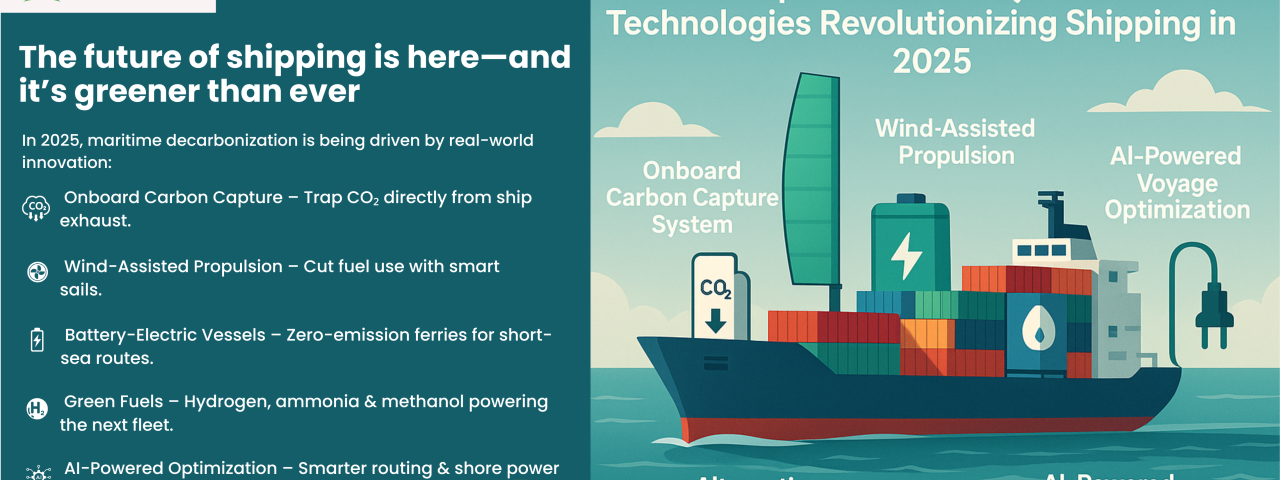
- Onboard Carbon Capture Systems
What It Is:
A relatively new solution, onboard Carbon Capture and Storage (CCS) traps CO₂ directly from a vessel’s exhaust. The carbon is chemically absorbed or filtered, then stored onboard for offloading at port.
Real-World Example:
Seabound, a London-based startup, developed modular carbon-capture units that use quicklime pellets to absorb up to 78% of CO₂ and 90% of sulfur from exhaust gases. These units are the size of a standard shipping container, making them easy to retrofit on existing vessels. Cargill and Lomar Shipping are among early adopters.
Why It Matters:
- Provides a transitional solution while waiting for green fuel infrastructure
- Helps shipowners comply with carbon taxes and emission caps
- Can be scaled rapidly for bulk carriers, tankers, and container ships
Status in 2025: Pilot systems successfully deployed; wide-scale rollout expected by late 2025.
- Wind-Assisted Propulsion (WAP)
What It Is:
Reimagining ancient wind-powered sailing with cutting-edge engineering, Wind-Assisted Propulsion includes rigid sails, suction wings, and spinning Flettner rotors to supplement engine power.
Real-World Example:
- Cargill’s Pyxis Ocean uses BAR Technologies’ "WindWings"—20-meter tall rigid sails. Initial trials showed 37% fuel and CO₂ reduction during voyages.
- Oceanbird, a concept by Wallenius Marine, features telescoping wing sails and is expected to cut emissions by up to 90%.
Why It Matters:
- Reduces reliance on fossil fuels without altering engine architecture
- Works best on long ocean routes where wind is abundant
- Easy to combine with other eco-technologies (hybrid propulsion)
Status in 2025: Deployed on bulkers and tankers; container ship applications in testing.
- Battery-Electric Propulsion & Electric Ferries
What It Is:
Fully electric ships or hybrid electric vessels use lithium-ion battery systems to propel the vessel or power onboard systems, offering zero-emission operation—especially effective for short-sea shipping.
Real-World Examples:
- Hull 096, a 400-foot ferry by Incat (Australia), is the world’s largest fully electric ferry. Scheduled to operate between Buenos Aires and Uruguay, it’s powered by 40 MWh of batteries and can carry 2,100 passengers.
- Artemis Technologies’ eFoiler ferry, operating in Belfast, lifts out of the water with hydrofoils, reducing drag and increasing efficiency by up to 85%.
Why It Matters:
- Zero emissions at sea and in port
- Ideal for ferry routes, harbor operations, and coastal traffic
- Minimal noise and vibration improve crew and passenger comfort
Status in 2025: Commercially viable in short-range and urban shipping zones; battery costs still limiting for long-haul.
- Alternative Green Fuels: Hydrogen, Ammonia & Methanol
What It Is: Fuels like green hydrogen and ammonia provide clean alternatives to diesel with zero or near-zero carbon emissions when produced renewably, while methanol—especially bio-methanol—offers up to 50% lower CO₂ emissions compared to conventional fossil fuels.
Real-World Examples: Hydrogen ferries are now operating in Norway and California. These vessels emit only water vapor and are powered by fuel cells. Green Pioneer, a vessel by Fortescue Future Industries, became the first to dock in London powered by green ammonia. Maersk has deployed more than 25 methanol-powered container vessels. When powered by bio-methanol, these ships achieve 65–70% lower lifecycle CO₂ emissions compared to traditional fossil fuels, offering one of the most scalable clean fuel alternatives available today.
Why It Matters:
- Scalable across vessel types, from tugs to tankers
- Complements renewable energy goals (especially green hydrogen)
- Fuel flexibility supports decarbonization roadmaps
Status in 2025: Hydrogen used commercially in small vessels; ammonia infrastructure expanding; methanol adoption accelerating with proven GHG reductions.
- AI-Powered Voyage Optimization & Port Electrification
What It Is:
Digital tools and AI platforms are transforming maritime operations by optimizing routes, minimizing idle time, and improving fuel efficiency through real-time environmental and vessel data. In parallel, port electrification—such as shore power (cold ironing)—allows ships to shut off auxiliary engines while docked and plug into clean electricity, drastically reducing emissions at berth.
Real-World Examples: StormGeo’s Strategic Power Routing dynamically plans energy-efficient routes, cutting fuel consumption by 6–12%. Maersk’s digital twin platform "Captain Peter" simulates vessel behavior and voyage options in real time for optimal decisions. Major ports like Rotterdam, Los Angeles, and Singapore have expanded shore power infrastructure, reducing port-side ship emissions by over 90%.
Why It Matters:
- Optimizes fuel burn, reduces voyage delays, and cuts operational costs
- Enables compliance with strict port emission control areas (ECAs)
- Enhances transparency, planning, and sustainability reporting
Status in 2025: Rapidly adopted in modern fleets; standard for new builds and ships operating in green corridors and urban port zones.
Why These Innovations Matter Now
As carbon pricing, fuel regulations, and consumer pressure escalate, these technologies are not just nice to have—they’re necessary. Combined, they offer a layered approach to decarbonization:
- Capture emissions onboard
- Reduce them through smarter routes and clean fuels
- Eliminate them entirely in port
This makes them adaptable for fleets of all sizes—whether you're retrofitting a bulk carrier or building the next-generation ferry.
Conclusion
The future of shipping is not just about going faster or carrying more—it’s about sailing smarter and cleaner. In 2025, the shipping industry is charting a sustainable course through the convergence of innovation, regulation, and ambition.
These technologies aren’t speculative—they’re in the water, and they’re working. For shipowners, regulators, and technology providers alike, the message is clear:
Green shipping is no longer an option. It’s an obligation—and a competitive advantage.
For those navigating this new era of maritime compliance, Ecosail Infotech’s EcoCompliance module offers the most reliable and integrated platform to track, analyze, and optimize your vessel’s environmental performance.
Stay compliant. Stay ahead.