What Is a CII Grade—and Why 'D' Matters
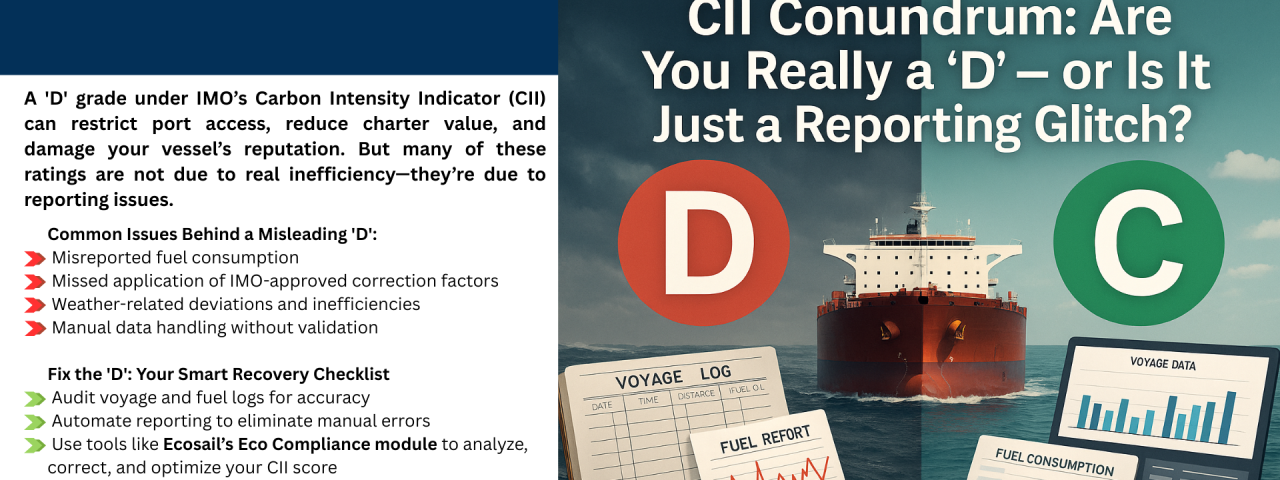
The Carbon Intensity Indicator (CII), enforced by IMO since 2023, rates vessels ≥ 5,000 GT based on CO₂ emissions per ton-mile (A–E). A 'D' grade can impact port access, charter hire, and reputation—making accuracy essential.
Common Causes Behind a Misreported ‘D’
- Misreporting of the daily fuel consumption
Current fuel consumption measurement methods—such as flowmeters, remote tank level monitoring, and manual tank soundings—are all susceptible to inherent inaccuracies. These discrepancies can negatively influence the vessel’s CII rating. In many cases, we observe over-reported consumption in daily reports, which further contributes to a decline in the CII score.
- Misapplication of Correction Factors
IMO allows adjustment for STS operations, cargo-heating (on oil & chemical tankers), and more—but if applied without proper evaluation of effect, the reported CII will appear worse.
- Weather Bias
Storm encounter, avoidance or re-routing increase use of fuel but don’t increase the distance proportionately. Such situations, though beyond control inflate CII numbers.
How You Might Not Be a D—Here’s What to Investigate
- Review voyage logs Ensure fuel consumption and distance travelled during voyage, anchorage or congestion are correctly logged.
- Apply all relevant corrections Validate use of STS, cargo heating or operational adjustments per IMO MEPC.355(78).
- Correctly and timely application of adjustments. FCvoyage adjustments provided by the IMO are correctly applied by timely and correct recording of such events.
- Analyze trade patterns Frequent short voyages? Consider pooling long-haul voyages or adjusting itineraries to arrive just in time by slow steaming to improve average efficiency.
Fixing the ‘D’: A Step-by-Step Strategy
Fixing the ‘D’: A Step-by-Step Strategy
Real-World Lessons & Critiques
- Blue Sky Maritime Coalition warns that CII doesn't account for waiting time, making 'D' ratings misleading and unfair.
- Oldendorff Carriers note that some vessels may emit more CO₂ chasing better grades, creating perverse incentives.
- Industry voices recommend refined metrics—like “pilot-station” assessments—to isolate true at-sea efficiency.
Conclusion
Before accepting a 'D' grade, dig deeper. It could reflect real under performance—but equally likely it's a result of misreporting, unclaimed corrections, or trade pattern peculiarities. Reviewing voyage data, applying IMO-approved corrections and collaborating with charterers can often turn a wrongful 'D' into a 'C' or better.