Introduction
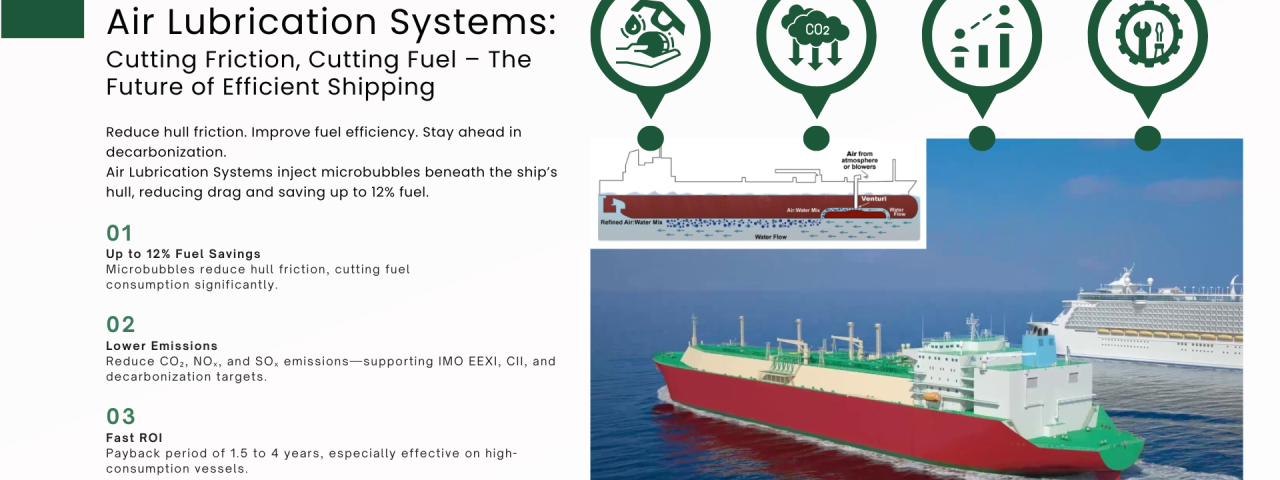
In the maritime industry's pursuit of sustainability and efficiency, Air Lubrication Systems (ALS) have emerged as a transformative technology. By introducing a layer of air bubbles beneath a ship’s hull, ALS significantly reduces hydrodynamic drag, leading to notable fuel savings and emission reductions.
How Air Lubrication Systems Work
ALS technology operates by injecting microbubbles between the ship's hull and the surrounding seawater. This air layer acts as a lubricating cushion, minimizing direct contact and thereby reducing frictional resistance. Given that frictional resistance accounts for over 50% of a vessel’s total hydrodynamic drag, mitigating this force translates to substantial energy savings.
There are two primary approaches to ALS:
- Air Layer Systems: These systems create a stable layer of air beneath flat sections of the hull.
- Microbubble Systems: These continuously inject fine bubbles along the hull's bottom, dynamically reducing water contact.
Fuel Savings and Efficiency Gains
Implementing ALS can lead to significant fuel consumption reductions, depending on the vessel type, operating profile, and system optimization.
Real-World Examples:
- Silverstream Technologies: Their ALS, installed on LNG carriers and cruise ships, routinely delivers 5–10% fuel savings, validated by third-party testing.
- Alfa Laval’s OceanGlide: Utilizing fluidic channels to distribute air precisely under flat-bottomed ships, OceanGlide has demonstrated up to 12% propulsion energy savings in trials.
- Mitsubishi's MALS System: Designed for bulk carriers and passenger ships, MALS has achieved a 10–15% reduction in carbon dioxide emissions.
Operational and Environmental Benefits
Beyond fuel savings, ALS contributes to vessel performance and maintenance in multiple ways:
- Reduced Engine Load: With decreased drag, ships require less engine power to maintain speed, minimizing wear and extending engine life.
- Lower Emissions: Reduced fuel consumption leads to fewer emissions—not only CO₂ but also NOₓ, SOₓ, and particulate matter—helping ships comply with EEDI, EEXI, and CII benchmarks.
- Anti-Fouling Effect: Recent studies suggest that ALS may help prevent biofouling by creating an environment less conducive to marine organism attachment, potentially reducing hull cleaning costs.
- Ease of Installation: Modern ALS systems, such as those from Silverstream and Alfa Laval, are modular and can be retrofitted to existing ships without major structural changes, enhancing accessibility across fleets.
Improving Vessel Efficiency Beyond Fuel
ALS offers several additional benefits that enhance a vessel’s overall performance and operational efficiency:
- Reduced Carbon Emissions: Every ton of fuel saved equates to approximately 3.15 tons of CO₂ not released into the atmosphere, aiding compliance with IMO’s EEXI and CII requirements, corporate decarbonization targets, and regulatory emission caps in emission control areas (ECAs).
- Optimized Route Efficiency: When combined with smart navigation software, ALS-equipped ships can optimize speed and routing to further reduce fuel use.
- Favorable Return on Investment (ROI): Although initial costs can range from $500,000 to $2 million, the payback period is often 1.5 to 4 years, especially on high-consumption vessels such as LNG carriers, large container ships, cruise liners, and tankers.
Advances in Air Lubrication Technology
Innovation in ALS is progressing rapidly, with companies focusing on:
- Smart Automation: Systems like Clean Marine’s ALS now adjust bubble flow based on draft and speed.
- Energy Efficiency: New passive systems like Armada Technologies' venturi-driven ALS reduce onboard energy demand.
- Retrofitting Support: Compact, modular ALS designs allow integration into existing vessels without major hull modifications.
In 2024, Silverstream Technologies secured orders for 18 new LNG carriers, highlighting the commercial maturity and scaling of the technology.
Design Integration and Hull Optimization
For maximum efficiency, ALS can be paired with:
- Hull Form Optimization: Modern ship designs increasingly feature flatter bottoms to allow better air distribution.
- Energy-Saving Devices: ALS works well with propeller boss cap fins (PBCF), pre-swirl ducts, and hybrid propulsion systems.
- Computational Fluid Dynamics (CFD) Modeling: CFD tools are used to simulate bubble flow and drag reduction for specific hull shapes, aiding in design optimization.
Future Outlook: A Mainstay of Sustainable Shipping
As the maritime industry moves toward decarbonization, ALS is no longer seen as experimental but as a critical enabler of greener operations. With rising fuel prices and tighter emission regulations, the business case for adopting ALS is stronger than ever.
Key Takeaways:
- Fuel Savings: 5–12%, depending on ship type and operating profile.
- Payback Time: 1.5–4 years.
- Emission Reduction: Thousands of tons of CO₂ annually per vessel.
- Compliance: Supports IMO 2030 and 2050 targets.
Conclusion
Air Lubrication Systems represent a significant advancement in maritime technology, offering tangible benefits in fuel efficiency and emission reductions. As the shipping industry faces increasing pressure to meet environmental regulations and reduce operational costs, ALS provides a viable solution with a compelling return on investment.